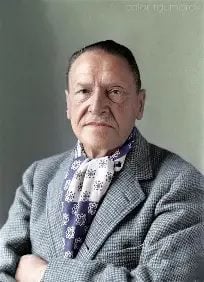
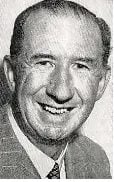
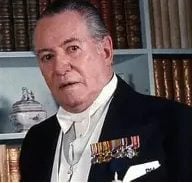
W. Somerset Maugham (1874–1965) stands as one of the most widely read and enduring English writers of the twentieth century, a master craftsman whose clarity of style, sharp psychological insight, and worldly sensibility earned him both popular acclaim and critical respect. Emerging in an era marked by modernist experimentation, Maugham forged a distinctive path: he privileged narrative over abstraction, character over theory, and emotional truth over stylistic novelty. His prose, elegant, lucid, and deceptively simple, made him accessible to millions while concealing a sophisticated command of structure and tone.
Maugham’s own life, shaped by early loss, medical training, extensive travel, and clandestine wartime service, provided the rich material that permeates his fiction. Novels such as Of Human Bondage and The Razor’s Edge reveal a deep preoccupation with human weakness, the search for meaning, and the tension between desire and duty. His short stories, many set in the far-flung outposts of the British Empire, exhibit his unrivalled gift for narrative economy and ironic revelation. Works like “Rain,” “The Outstation,” and “The Letter” exemplify his talent for exposing the fragile facades of social respectability and the complexity of moral choice.
Critics have often noted Maugham’s stance as a detached observer. With the cool eye of a clinician, perhaps a legacy of his medical background, he dissected human behaviour with precision, yet without denying his characters’ vulnerability or dignity. He understood the contradictions of the human heart and portrayed them without sentimentality or judgment.
While never fully embraced by the modernist canon, Maugham’s reputation has endured due to the lasting pleasures of his storytelling and the universality of his themes. His works continue to resonate because they illuminate, with honesty and irony, the ordinary struggles of people striving to live meaningful lives. In a literary age that often prized obscurity, Maugham remained committed to the art of clear, compelling narrative—and it is this commitment that secures his place among the great storytellers of English literature.
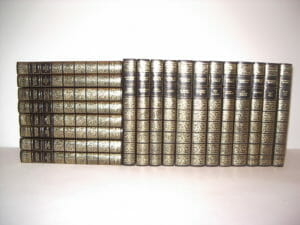
One of the most popular Maugham collections was produced by Heron books through the 1960’s and 1970’s you can view a full list for this collection at Heron Books Collections
John Galsworthy (1867–1933) stands as one of the most distinguished figures in early twentieth-century English literature—a novelist, playwright, and essayist whose work helped define the moral and social conscience of his age. Galsworthy’s ancestral heart was in Devon. He was intensely interested in his own origins and descent through a long line of Devon farmers. It was to Devon that he traced his rural forebears, and Galsworthy found sanctuary from the pressures of life in London high society. He also found a creative space in which his imagination could roam and he could craft his classic series of novels.
Best known for The Forsyte Saga, Galsworthy devoted his writing to exploring the tensions of a society in transition: the slow decline of Victorian certainties, the rise of modern sensibilities, and the friction between individual desire and the rigid structures of class, property, and convention. At its heart, The Forsyte Saga follows the fortunes, conflicts, and transformations of the Forsytes, an upper-middle-class English family whose wealth is rooted in commerce and property. The story spans several decades—from the Victorian era into the early 20th century—and uses the family’s experiences to explore: Possession and ownership; Marriage, love, and social convention; The shifting values of English society; The decline of rigid Victorian moral codes. The saga’s main early conflict centres around Soames Forsyte, a cautious, status-minded solicitor, and his beautiful but emotionally distant wife Irene Heron. Their troubled marriage becomes a symbol of the tension between materialism and emotional freedom. The Forsyte Saga provides both a detailed social portrait of its era and a psychological study of characters caught between tradition and change. It’s praised for its elegant prose, sharp social criticism, and rich, interwoven storytelling.
A master of subtle psychological insight, Galsworthy wrote with quiet realism rather than flamboyant flourish. His prose is marked by measured clarity, gentle irony, and a deep compassion for human frailty. As a dramatist, he challenged social injustice—campaigning against prison abuses, inequality, and the oppression of women—while in his fiction he produced some of the English canon’s most memorable portraits of the middle and upper-middle classes, caught between tradition and change.
Awarded the Nobel Prize in Literature in 1932, Galsworthy remains a writer of moral depth and narrative elegance, whose work reveals the complexities of human motives and the often-unspoken tragedies of ordinary lives.
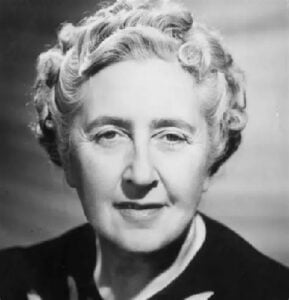
Agatha Christie, often hailed as the “Queen of Crime,” is one of the most prolific and celebrated authors in the world of mystery and detective fiction. Born in 1890 in Torquay, England, Christie wrote over 66 detective novels, 14 short story collections, and several plays, captivating readers with her keen insight into human nature and her intricate plots. Her works have been translated into over 100 languages and have sold billions of copies, cementing her as one of the best-selling authors of all time.
Christie had long been a fan of detective novels, having enjoyed Wilkie Collins’s The Woman in White and The Moonstone, and Arthur Conan Doyle’s early Sherlock Holmes stories. She wrote her first detective novel, The Mysterious Affair at Styles, in 1916. It featured Hercule Poirot, a former Belgian police officer with “magnificent moustaches” and a head “exactly the shape of an egg”, who had taken refuge in Britain after Germany invaded Belgium. Christie’s inspiration for the character came from Belgian refugees living in Torquay, and the Belgian soldiers she helped to treat as a volunteer nurse during the First World War. In her autobiography Agatha reveals a regret about the character; she wished she had not made him a retired police officer as by the time the series of books in which he appeared has concluded his age in reality would have been well in excess of 100 years old.
Agatha Christie Collection – Hamlyn
Her first husband was Archibald Christie; they married in 1914 and had one child before divorcing in 1928. Following the breakdown of her marriage and the death of her mother in 1926, she made international headlines by going missing for eleven days. Christie disappeared from her home in Sunningdale on 3 December 1926. The following morning, her car, a Morris Cowley, was discovered at Newlands Corner in Surrey, parked above a chalk quarry with an expired driving licence and clothes inside. On 4 December, the day after she went missing, it is now known she had tea in London and visited Harrods department store where she marvelled at the spectacle of the store’s Christmas display. On 14 December 1926, she was located at the Swan Hydropathic Hotel in Harrogate, Yorkshire, 184 miles (296 km) north of her home in Sunningdale
During both world wars, she served in hospital dispensaries, acquiring a thorough knowledge of the poisons that featured in many of her novels, short stories, and plays. Following her marriage to archaeologist Max Mallowan in 1930, she spent several months each year on archaeological excavations in the Middle East and used her first-hand knowledge of this profession in her fiction. Despite her immense success, she was known for her modesty and reclusive nature, often shying away from the public eye.
Christie’s most famous characters, Hercule Poirot and Miss Marple, have become iconic figures in detective fiction. Poirot, the meticulous Belgian detective with his “little grey cells,” and Miss Marple, the sharp-witted amateur sleuth from the quiet village of St. Mary Mead, embody the contrast between methodical reasoning and intuitive insight. Through these characters, Christie explored complex themes such as justice, morality, and the darker aspects of human behaviour, all while maintaining a suspenseful and entertaining narrative.
Her writing style is known for its crisp dialogue, clever misdirection, and masterful plotting. Christie had a remarkable ability to create seemingly unsolvable mysteries that left readers guessing until the very end. Her works have inspired countless adaptations for film, television, and stage, ensuring her legacy endures in popular culture.
Whether you’re a seasoned fan or a newcomer to her work, reading Agatha Christie is always an invitation to solve the puzzle before the detective does, a challenge few can resist.
Thomas Hardy (1840–1928) is one of the most significant and influential figures in English literature, known for his richly detailed novels and poems that grapple with themes of fate, human suffering, and the indifference of nature. His works offer a stark, yet poignant, exploration of the complexities of rural life in Victorian England, and they provide a deep commentary on the constraints of social and moral systems. Hardy’s blend of realism, naturalism, and elements of romanticism made him a literary figure ahead of his time.
Born in the village of Higher Bockhampton in Dorset, Hardy grew up deeply influenced by the natural world and rural traditions. His early exposure to the landscape of southwestern England, as well as his upbringing in a working-class family, shaped much of his later writing. Hardy’s formal education was at local schools and later at King’s College London, where he studied architecture. However, it was his passion for writing that eventually led him to literary success. Hardy’s early works were influenced by Romantic poets like Wordsworth and Byron, but his mature works, especially his novels, were informed by his keen observations of the harsh realities of life, much influenced by the rise of industrialization and the changing social landscape.
Hardy’s novels are often set in the fictional region of Wessex, a rural landscape that mirrors his own southwest England. Through this setting, he explores the intersection of human will and the indifferent forces of nature, fate, and society. His characters frequently face immense personal struggles, whether due to the constraints of class, gender, or social expectations. His portrayal of women, often strong-willed and tragic figures, and his critique of Victorian morality are central to many of his works. Some of his major novels include; Tess of the d’Urbervilles, Far from the Madding Crowd, The Mayor of Casterbridge, and Jude the Obscure – Hardy’s last novel.
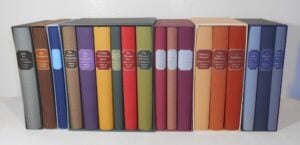
Thomas Hardy – Folio Society
In addition to his novels, Hardy was a prolific poet, and many of his poems reflect the same themes of fatalism, love, loss, and the passage of time. His poetry often expresses a deep melancholy about the human condition and its relationship with nature. Some of his most famous poems include; “The Darkling Thrush” and “The Convergence of the Twain,” which mourn the tragic sinking of the Titanic.
Hardy’s early novels were written within the conventions of Victorian realism, but as his career progressed, his work took on a darker, more naturalistic tone. He was deeply critical of the rigid moral codes and social systems of the time, often portraying characters caught in webs of fate or social injustice that they could not escape. Hardy’s distinctive narrative voice, which blends humour with a deep sense of sorrow, and his vivid descriptions of the English countryside, set his works apart from those of his contemporaries.
In his later years, Hardy became disillusioned with the novel as a form and turned more fully to poetry, writing hundreds of poems after the publication of Jude the Obscure. Hardy’s works were not universally appreciated in his time—his criticisms of social conventions and his unflinching portrayal of human suffering often shocked Victorian sensibilities. However, his influence grew steadily in the 20th century, and his works were lauded for their psychological depth and moral complexity.
Today, Hardy is considered one of the great English novelists and poets, whose works continue to resonate with readers for their exploration of the darker sides of human experience. His themes of love, loss, fate, and the inexorable march of time remain timeless, ensuring his place as a master of the Victorian era and beyond. His literary career spanned the transition from the Victorian era to the modern period, and his works captured the shifting tides of society, morality, and individual agency. His portrayal of rural life, complex characters, and fatalistic themes continue to captivate readers, cementing his legacy as one of the defining authors of English literature.
James Joyce (1882-1941) is one of the most influential and innovative writers of the 20th century. Renowned for his complex and experimental use of language, his works challenge conventional narrative forms and explore the intricacies of human consciousness. Joyce’s writing often blurs the boundaries between reality and perception, employing stream of consciousness techniques, intricate wordplay, and dense allusions to mythology, history and literature.
Born in Dublin, Ireland, Joyce’s experiences in his home city profoundly shaped much of his work. His most famous novels, A Portrait of the Artist as a Young Man (1916), Ulysses (1922), and Finnegans Wake (1939), reflect his ongoing exploration of identity, self-expression, and the relationship between the individual and society. In particular, Ulysses is celebrated for its groundbreaking narrative style and its deep engagement with the ordinary lives of Dublin’s citizens, all while drawing on the epic structure of Homer’s Odyssey.
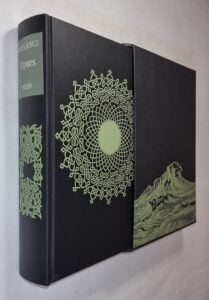
Ulysses – Folio Society
Joyce’s writing also reflects a preoccupation with the tensions between modernity and tradition, especially in the context of Irish culture and politics. His works are often infused with a sense of disillusionment and a questioning of the Catholic and nationalist ideologies that dominated his homeland.
Although his works were initially met with controversy due to their explicit content and unconventional style, Joyce’s reputation has only grown over time. His innovations in narrative technique, especially in Ulysses, made him a key figure in the modernist movement and earned him a lasting place in the literary canon. Today, Joyce’s works continue to be studied and admired for their linguistic inventiveness and philosophical depth.
The James Joyce Centre is an educational charity, museum, and cultural institution which promotes the life, literature and legacy of one of the world’s greatest writers, James Joyce. Situated in a stunning Georgian townhouse in Dublin’s North Inner City, the Centre offers visitors historical and biographical information about James Joyce and his influence upon the literary world. We host walking tours, exhibitions, workshops, and lectures for Joycean scholars as well as the casual visitor. See the door of the famous No. 7 Eccles Street from Ulysses, art exhibitions, and other items that bring the author and his works to life. Participate in our many events, including readings, adaptations, and performances of Joyce’s best loved works.
Nevil Shute (1899-1960) – Nevil Shute Norway holds a distinguished place in twentieth century English fiction. An aeronautical engineer by profession and a novelist using Nevil Shute as his pen name, he spent his later years in Australia. his novels, written in clear and unaffected prose, reveal an abiding faith in the dignity of ordinary people and in the enduring values of decency, courage, and perseverance.
Heron Books Collection
Born in 1899 and trained as an engineer, Shute spent the first part of his life immersed in the world of aviation. His technical expertise and disciplined mind shaped his literary style: his narratives are structurally sound, meticulously detailed, and suffused with an engineer’s respect for human ingenuity. Yet beneath the calm, methodical surface of his prose lies a deep emotional intelligence. Whether set in wartime Malaya, postwar Australia, or a future devastated by a nuclear catastrophe, his stories consistently affirm the resilience of the human spirit.
Shute’s most celebrated novels – A Town Like Alice, On The Beach, No Highway, and Round The Bend – demonstrate both the range and coherence of his vision. A Town Like Alice celebrates love and endurance against the backdrop of war and reconstruction, while On The Beach offers a haunting meditation on moral courage in the face of extinction. No Highway and Round The Bend explore the ethical dimensions of scientific responsibility and the potential for spiritual redemption in the modern industrial age.
Stylistically, Shute’s prose is notable for its restraint and lucidity. He wrote not to impress, but to communicate. His language, stripped of ornament, carries the quiet authority of a man who valued clarity over cleverness. In this, he stands apart from many of his contemporaries, preferring sincerity to sophistication, and emotional truth to literary experiment. His work reminds us that heroism often lies in ordinary acts, that courage can be quiet, and that hope endures even in the shadow of loss.
In an age marked by speed, irony, and moral uncertainty, Shute’s calm voice continues to offer something rare and valuable: a literature of decency, written with faith in humanity and an unshakeable belief in the power of goodness.
Several biographies have been written about Nevil Shute, including:
“Slide Rule: The Autobiography of an Engineer”: Shute’s own account of his life and career.
“Parallel Motion: A Biography of Nevil Shute Norway” by John Anderson (2011).
“Shute: The Engineer Who Became a Prince of Storytellers” by Richard Thorn (2017).
£6.99
Acting and Stagecraft Made Simple Bowskill 1973 Click To View
Click To View
Scottish Songs Findlater Campbell Lomond Books 2003 – A collection of more than 80 traditional compositions arranged for voice and piano. Click To View
£8.99
London Ward Lock Illustrated Guide 2008 – Originally published in the early 1950’s, all information is from a pre-1960’s edition. Click To View
Little Men Louisa M Alcott Collins Classics 1960 – The third book in the Little Women series. Click To View
£9.99
Churchill The Man of the Century Neil Ferrier 1955 – A pictorial biography detailing his life and career. Click To View
E=mc2 Biography of the World’s Most Famous Equation Bodanis 2000 – In this fascinating ‘biography’ David Bodanis tells the story of one of the greatest scientific discoveries in history. Click To View
A Dictionary of British History Secker & Warburg 1981 – The book covers the history of the British Isles and its overseas possessions from the Roman conquest until 1970. Click To View
My Lively Lady Alec Rose Nautical Publishing 1968 – Alec Rose`s own story which includes two heroines, his boat `Lively Lady`, and Dorothy his wife. Click To View
Arms of the County Councils of Scotland David Patton Argyll 1977 – Full page colour plates of Council arms, with heraldic explanations. Click To View
£10.99
Edward Lear’s Nonsense Omnibus Warne c1966 – With all the original pictures, verses and stories. Click To View
A Social History Of Nineteenth-Century France Price Holme Meier 1987 – This book argues that the social impact of the French Revolution has been greatly exaggerated, and that in 1815 France was still predominantly a rural and pre-industrial society. Click To View
Tropic of Capricorn Henry Miller Guild 1988 – A riotous and explosive mixture of joys and frustrations, Tropic of Capricorn chronicles Miller’s early life in New York, from his repressive Brooklyn childhood spent amongst ‘a galaxy of screwballs’ to frantic, hilarious years of dead-end jobs and innumerable erotic adventures. Click To View
£11.99
Click To View
A World Too Vast Columbus Alexander McKee 1990 – The Four Voyages of Columbus. Illustrated with colour photographs, contemporary woodcuts, engravings and maps. Click To View
A Speech On The Death Of King George The Fifth 1936 – Broadcast from London by the Prime Minister on Tuesday 21st 1936 Click To View
Villette Charlotte Bronte Everymans 1992 – Charlotte Bronte’s most autobiographical novel. Click To View
£12.99
Napoleon His Wives and Women Christopher Hibbert HarperCollins 2002 – Entertaining biography of Napoleon Bonaparte – looking at his relationships with his wives, mistresses and women. Click To View
The Secret History Procopius Folio Society 1990 – The Secret History covers roughly the same years as the first seven books of the History of Justinian’s Wars and appears to have been written after they were published. Click To View
Monkeys In The Dark Blanche dAlpuget Aurora 1980 – Novel based in troubled Indonesia. Click To View
Sermons and Soda-Water John O’Hara Cresset 1961 – These sermons admirably fulfil their author’s intention, which is to record the way people talked and felt during the troubled interim from the end of one world war to the end of another. Click To View
Muddied Oafs The Last Days of Rugger Richard Beard Yellow Jersey 2003 – There is Rugby Union: the fast, compelling, TV-friendly combat sport in which sponsored gladiators are sold on their ability to crash into each other at top speed, and sometimes even to avoid each other and score. And then there’s Rugger! Click To View
£14.99
Alexander Solzhenitsyn A Century In His Life Thomas Little Brown 1998 – This is as much a disturbing, haunting history of the twentieth century as it is a biography of a great novelist. Click To View
My Work at the Surete Jean Belin Harrap 1950 – From police constable to Commissioner, including much on his battles with the Gestapo in WW2 & with the fascist Cagoulards & Petainists. Click To View
Atlas of Medieval Europe Routledge 1998 – The book’s maps covers the period from the fall of the Roman Empire through to the beginning of the Renaissance. Click To View
Arthurian Legends Coghlan Claremont Books 1996 – In this book Ronan Coghlan has examined all the different strands of the Arthurian myth, bringing together material from a wide range of sources such as Geoffrey of Monmouth, Malory, Chrétien de Troyes, the Mabinogion and the English Gawain Cycles. Click To View
Gentlemen Prefer Blondes Anita Loos Folio Society 1990 – The Intimate Diary of a Professional Lady is a comic novel written by Anita Loos. Click To View
Point Counter Point Aldous Huxley Folio Society 1958 – Huxley characterizes the symptoms of “the disease of modern man” in the manner of a composer — themes and characters are repeated, altered slightly, and played off one another in a tone that is at once critical and sympathetic. Click To View
£15.99
Secret Societies David V Barrett Godsfield Press 2008 – The book explores the covert societies that have exerted power and influence over millions of people throughout history. Click To View
A Summer In Lochaber Catriona Fforde 2002 – The history of the first of the Jacobite Risings – not the 1715 rebellion but that of the summer of 1689. Click To View
Complete Illustrated Works Shakespeare Bath Press 1988 – The illustrations in this volume are taken from various classic editions of the plays and from paintings on Shakespearean themes. Click To View
The Venus of Konpara John Masters Michael Joseph 1960 – A moving and exciting tale of six people in search of an ancient Indian statue and the tumultuous effect the search has on their lives. Click To View
£16.99
Cheri Colette Folio Society 1963 – Set in the ‘demi-monde’ of the Parisian courtesans before World War One, it tells the story of Lea an aging courtesan who has for a number of years been teaching Frederic Pelous (Cheri) a handsome, spoilt, sardonic young man about love. Click To View
£17.99
The Toynbee Convector Ray Bradbury Grafton 1989 – An old woman learns what it truly means to believe in ghosts in ”On the Orient, North”; another woman discovers a mysterious ”Trapdoor” in a house she has occupied for years; and an old man attempts to change his own past in ”A Touch of Petulance” in this new collection of 23 stories by one of sf’s grand masters. Click To View
£19.99
The Norse Atlantic Saga Gwyn Jones Oxford 1965 – Being the Norse Voyages of Discovery and Settlement to Iceland, Greenland, and America documented by Professor Gwyn Jones. Click To View
Click To View
Aylmer Court Henly Arden Wells Gardner Darton 1894 – A novel set in the time of Cromwell. Click To View
Voyages to the Moon and the Sun Cyrano de Bergerac Folio Society 1991 – Originally published in 1657 and 1662, respectively, the novels combined science fiction and political satire. Click To View
Books As Christmas Presents – The Superb Heron Books Collections
Heron Books / Edito-Service were responsible throughout the 1960s, 70s and early 80s for publishing ‘Collectors Editions’ of famous authors (illustrated, with introductions, decorated leatherette covers, silk bookmark, rarely dated, with some leather Special Editions). The books were sold directly through newspaper advertisements on a monthly, something like a book club, basis. The books were sold on a Free Approval basis with never any commitment to buy either the volume sent or any further volumes. Heron Books were phenomenally successful in their time and claimed that they sold approaching 100 million volumes world wide.
As well as substantial Author Specific collections they also produced a variety of sets such as; Masters of Espionage, a terrific collection of 20 top spy novels; Books That Changed Man’s Thinking, a 29 volume collection of some of the most significant and powerful books ever written; Poets Of The English Language, a 5 volume anthology spanning 600 years; Women Who Made History, a 20 volume collection of women of note; and Men of Destiny, no details for this collection as yet.
And lets not forget the superb 39 Volume Agatha Christie Thriller Collection.
Currently Selling – Several Complete Agatha Christie collections, Joseph Conrad, Hammond Innes, Alistair Maclean, Somerset Maugham, J B Priestley, D H Lawrence, Nevil Shute, Colette, Rudyard Kipling, John Galsworthy, Wilbur Smith, John Steinbeck, Daphne Du Maurier, Robert Louis Stevenson, etc.
Gift Suggestion – Why not put your own collection together? If you are interested in more than one book as a gift then please email me with your selections and I will confirm availability and give you a Special Price
Dennis Yates Wheatley (1897-1977) was born in Brixton, south London, the son of a wine merchant. His best-known books were occult and supernatural thrillers, starting with The Devil Rides Out (1934); but from the beginning there were science fiction elements there too. Black August (1934) is about a future war, after which Britain is rescued from collapse by a palace coup. His large output includes other science fiction novels, such as They Found Atlantis (1936) (they found Atlantis), Sixty Days to Live (1939) (about the arrival of a destructive comet), and Star of Ill-Omen (1952) (which features flying saucers). A library of witchcraft and adventure. Dennis Wheatley, storyteller supreme, made a lifelong study of the occult. His meticulous research into the black arts reveals almost unbelievable sorcery. He warned. ‘By participating in Satanic Rites, however sham, one can make oneself a focus for Evil.’ No writer cared more about authenticity. This is true not only of his Satanist books, but also of his many other novels.
Wheatley was commissioned as a 2nd Lieutenant into the Royal Field Artillery during the First World War. Dennis was gassed in a chlorine attack during Passchendaele and was invalided out, having served in Flanders, on the Ypres Salient, and in France at Cambrai and Saint-Quentin. In 1919 he took over management of the family’s wine business. In 1931, however, after his father’s death, and with business having declined because of the Great Depression, he was financially over-extended, faced near bankruptcy, and was forced to sell his wine business. Knowing his love of telling tales, his wife suggested he write a book. DW wrote a detective novel called ‘Three Inquisitive People’ which introduced the Duke de Richleau and his friends and it was accepted for publication by Hutchinson, who were to be his publishers for the rest of his life. Before the book could be published he wrote a second book, an adventure story set in Russia and featuring the same set of heroes – ‘The Forbidden Territory’. Hutchinson decided this was a better novel and should be published first. He followed this with an ‘out of series’ novel which he wrote in a fortnight, and then went back to the writing of impeccably researched novels with ‘Black August’, which featured his second principal hero Gregory Sallust, and ‘The Fabulous Valley’. In 1934 he wrote an occult novel, ‘The Devil Rides Out’. Frequently rated as the best occult novel of the twentieth century, and it is his most famous work.
During the Second World War Wheatley was a member of the London Controlling Section, which secretly coordinated strategic military deception and cover plans. His literary talents led to his working with planning staffs for the War Office. He wrote numerous papers for them, including suggestions for dealing with a possible Nazi invasion of Britain (recounted in his works Stranger than Fiction and The Deception Planners). The most famous of his submissions to the Joint Planning Staff of the war cabinet was on “Total War”. He took part in the plans for the Normandy invasions.
After the War, Wheatley bought a mini country mansion in seaside Lymington in Hampshire, and he continued to write books, introducing a third principal character, Roger Brook, whose exploits took place in the Napoleonic era. He worked hard and to a well-disciplined routine. For around eight months of the year DW would devote himself to his writings. He would rise mid-morning and sometimes go to bed well after midnight, depending on how his writing was going. He took the remaining months off to go travelling, partly for pleasure and partly to research his next books. In the days when international travel was a distinct privilege, he went round the world twice, and used countries as diverse as Sri Lanka, Mexico and Egypt as backdrops for his books. During this time several of his books were filmed by Hammer, the most famous being ‘The Devil Rides Out’ with his friend Sir Christopher Lee playing the role of the Duke, a role which he enjoyed enormously.
Dennis Wheatley wrote sixty five books in all, with fifty six being novels and the remainder non-fiction. Eleven featured the Duke de Richleau, eleven Gregory Sallust, and twelve involved Roger Brook. Some nine of these are considered ‘Black Magic’ novels – a genre for which he is particularly famous.
By the nineteen sixties, Wheatley was selling over a million copies of his novels a year; his work was sold in around twenty nine countries and translated into over twenty eight languages, and altogether he is estimated to have sold something like fifty million copies of his books in his lifetime.
52 Volume Dennis Wheatley
He wrote with great intensity and created an amazing variety of characters and situations. The 52 volume Heron Edition of Wheatley’s novels, which includes his espionage and adventure stories, as well as the occult, is the only finely-bound edition in the world.
The craftsmanship is of the highest standard. Scarlet Kidron and lavish golden and black embellishing have been used to startling effect. The illustrations were specially commissioned from English artists.
Gift Suggestion – Why not put your own collection together? If you are interested in more than one book as a gift then please email me with your selections and I will confirm availability and give you a Special Price
This website uses cookies to improve your experience. We'll assume you're ok with this, but you can opt-out if you wish.AcceptRejectRead More
Privacy & Cookies Policy
Privacy Overview
This website uses cookies to improve your experience while you navigate through the website. Out of these, the cookies that are categorized as necessary are stored on your browser as they are essential for the working of basic functionalities of the website. We also use third-party cookies that help us analyze and understand how you use this website. These cookies will be stored in your browser only with your consent. You also have the option to opt-out of these cookies. But opting out of some of these cookies may affect your browsing experience.
Necessary cookies are absolutely essential for the website to function properly. This category only includes cookies that ensures basic functionalities and security features of the website. These cookies do not store any personal information.
Any cookies that may not be particularly necessary for the website to function and is used specifically to collect user personal data via analytics, ads, other embedded contents are termed as non-necessary cookies. It is mandatory to procure user consent prior to running these cookies on your website.